
Marion County Court Records After Arrest
Marion County court records after an arrest are built in stages. The jail booking creates the first public custody trail, often with a booking or arrest number, charge text, bond field, court date, warrant number, and arresting agency if those fields are enabled in the roster. The court record is different. It begins when an affidavit, complaint, information, indictment, motion, judgment, or other filing is placed with the proper court or clerk. That filing is the record that shows what the government chose to charge, not just what appeared at intake.
For the custody side, use Marion County jail inmate records to confirm booking status and facility placement. For booking photos, use the separate Marion County jail mugshots page because a court file is not a photo gallery. After the person has a court case, the key offices are Marion County Justice Court, the Circuit Clerk, Circuit Court, the County Prosecuting Attorney, and the 15th Circuit District Attorney. Each office has a different role in the arrest-to-court path.
The official Marion County courts page is the local source for court addresses and the first-appearance rule. It states that all felony cases are first heard in Justice Court for initial appearance and affidavit filing, and that judges hold court sessions at the jail three times each week to secure an initial appearance within three days of arrest.
Marion County's court contacts page shows the local court routing that follows a jail arrest.
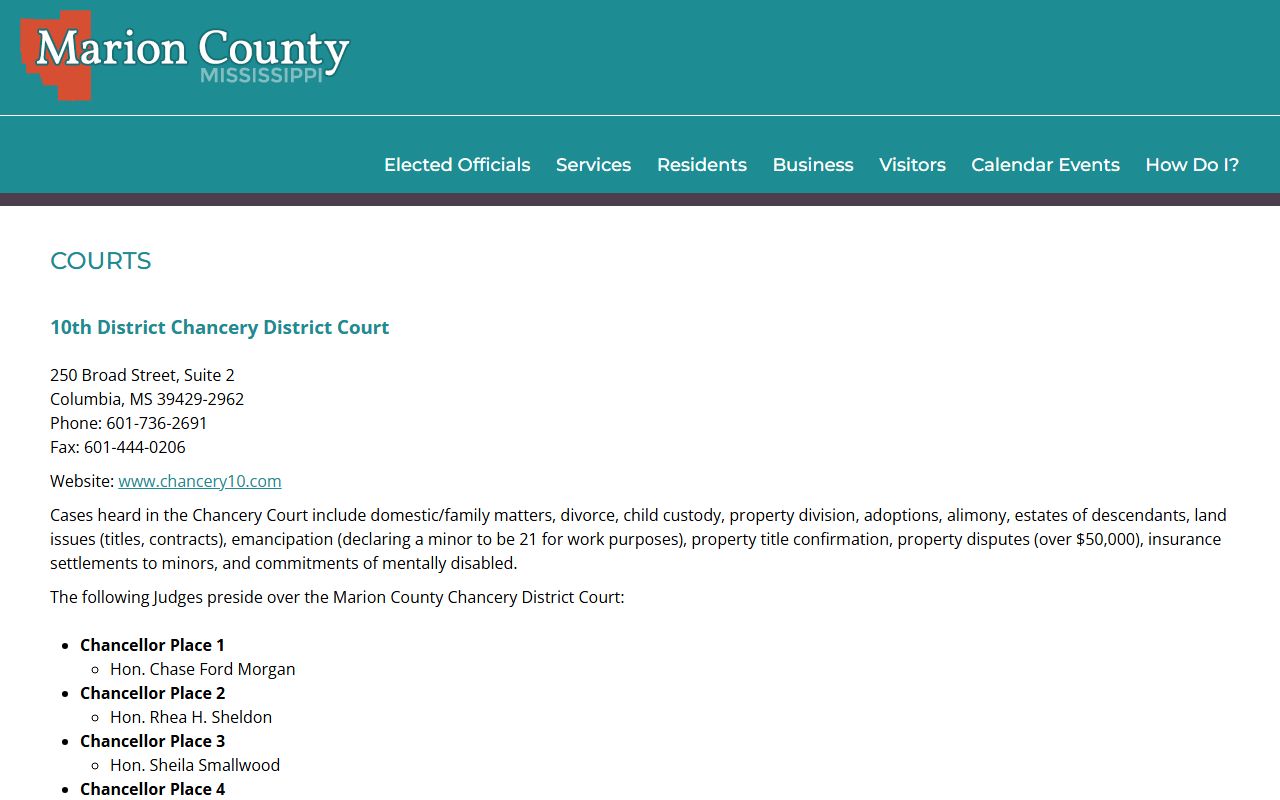
That local court routing matters because a felony charge may appear in Justice Court before a later Circuit Court filing is visible.
Find Marion County Court Records After Arrest
Start with the name used at booking, then search by case number when a clerk, roster entry, bond paper, subpoena, or court notice provides one. Mississippi Electronic Courts and PAMEC are the remote access path for many filed court records, but remote document access is account based. If a user cannot access the portal, the clerk's office remains the practical fallback for filed criminal cases, indictments, motions, subpoenas, judgments, and executions.
- Check the sheriff-linked roster first for the arrest charge, court date, warrant number, bond type, and arresting agency.
- Contact Marion County Justice Court for the first appearance, affidavit, DUI, traffic, or county ordinance matter.
- Use Circuit Court or the Circuit Clerk for felony filings, indictments, motions, subpoenas, judgments, and later criminal case records.
- Use Mississippi Electronic Courts/PAMEC if remote access is available and the record has been filed in a participating court.
- If the portal does not show the case, ask the clerk which court has the filing or whether the record is confidential, sealed, older, or not yet opened.
The Mississippi Electronic Courts page is the statewide access point for MEC and PAMEC information. It is not the same as the JailTracker roster. A person can be in custody before an online court case is searchable, especially while the prosecutor reviews the booking charge or while an affidavit is being filed.
| Search Field | Type | Required | Use in Marion County Court Records |
|---|---|---|---|
| PAMEC login | Account login | Yes for remote documents | Needed for subscriber or account access to remote court records. |
| Party name | Search text | No | Use the booked name, then try known aliases or spelling variants. |
| Case number | Search text | No | The most precise way to locate a filed criminal case. |
| Court or county | Filter | Usually | Select the correct Marion County court when the portal allows filtering. |
| Document view | Subscriber action | Yes for copies | Use the portal instructions or the clerk for current copy access rules. |
Marion County Arrest Court Contacts
Justice Court is the first local stop for all felony cases after a Marion County jail arrest. It also handles DUI matters, county ordinance violations, and traffic tickets from the Mississippi Highway Patrol and Marion County Sheriff's Department. The Justice Court office is at 500 Courthouse Square, Suite 2, Columbia, MS 39429, and the phone number is 601-736-2572. Judges hold jail sessions three times weekly to support the initial-appearance rule.
Circuit Court and the Circuit Clerk handle the later felony record trail. The Circuit Court and Circuit Clerk are at 250 Broad Street, Suite 1, Columbia, MS 39429, phone 601-736-8246. Circuit Clerk Janette Nolan receives and files indictments, motions, lawsuits, related papers, subpoenas, judgments, and executions. That makes the clerk central when a booking charge has moved beyond first appearance and into a filed felony case.
Marion County Justice Court
500 Courthouse Square, Suite 2
Columbia, MS 39429
601-736-2572
Initial appearances, affidavits, DUI, county ordinance, and many traffic matters.
Marion County Circuit Clerk
250 Broad Street, Suite 1
Columbia, MS 39429
601-736-8246
Felony filings, indictments, motions, subpoenas, judgments, and later case records.
The 15th Circuit District Attorney, Hal Kittrell, is at 500 Courthouse Square, Suite 3, Columbia, MS 39429, phone 601-731-1476. Office hours are 8am to 5pm CST, Monday through Friday. The County Prosecuting Attorney is Lawrence Hahn at 338 Church Street, Columbia, MS 39429, phone 601-731-5020. The DA handles felony prosecution, while the county prosecutor covers state representation in felony matters before county justice or county court, criminal appeals from justice or county court to circuit court, grand-jury matters, youth-court misdemeanors, and other assigned cases.
Marion County Charging Documents
Charging documents explain why a court record exists after a jail arrest. An affidavit or complaint may support the first appearance in Justice Court. A prosecutor may later proceed through an information when allowed, or a grand jury may return an indictment for felony prosecution. The words can look similar on a docket, but each document has a different source and weight.
| Document | Who Creates It | Common Use | What to Check |
|---|---|---|---|
| Complaint or affidavit | Officer, complainant, or prosecutor through the lower court process | First appearance, misdemeanor, traffic, ordinance, and early felony path | Charge text, sworn facts, warrant link, and first court date. |
| Information | Prosecutor | Formal prosecution when that charging route is available | Filed charge, case number, defendant name, and any amendments. |
| Indictment | Grand jury | Felony prosecution in Circuit Court | Counts, offense dates, statutes, and arraignment setting. |
An indictment or information can differ from the charge shown on a roster. Prosecutors may amend, reduce, add, dismiss, or decline charges after reviewing reports, witness statements, lab results, criminal history, and the facts available at the time of filing.
Marion County Charge Status
A Marion County court record after an arrest should be read by status, not just by charge name. Pending means the case or count is still open. Dismissed means the court has ended that count without a conviction. Nolle prosequi, often called nolle pros, means the prosecutor has declined to continue that count. Amended or reduced means the filed charge changed during prosecution.
| Status | Plain Meaning | Record Caution |
|---|---|---|
| Pending | The charge is open and no final result is shown. | Do not treat it as a conviction. |
| Amended or reduced | The prosecutor or court changed the charge. | Compare the original booking charge with the filed case. |
| Dismissed | The charge was ended by the court. | Other counts in the same case may still remain. |
| Nolle prosequi | The prosecutor chose not to proceed on that count. | Check whether the order applies to all counts or only one charge. |
| Convicted | A plea, verdict, or judgment produced a conviction. | Read the judgment for sentence and disposition terms. |
Bond is tied to custody status, but it is not the same as case status. Marion County bond information may appear in JailTracker through bond amount and bond type fields. Justice Court handles early court movement and first appearance. Cash bond means money is paid directly under court rules. Surety bond uses a licensed bail bond agent. Personal recognizance, or PR, is release based on a promise to appear. Property bond uses property as security if the court accepts it. A no-bond hold, detainer, MDOC hold, federal hold, ICE detainer, or other-county warrant can block release even when one count has a listed bond.
Justice Court fine-payment instructions should not be treated as jail bond rules. Marion County fine and ticket payments have their own MyFinePayment and clerk process, while active release eligibility should be confirmed with the facility or the court that set the bond.
Marion County Warrants After Arrest
No dedicated official Marion County active-warrant list was located in the sheriff or county sources reviewed for the research. That gap changes the search path. If a person has already been booked, the sheriff-linked roster may show a warrant number, hold, charge, bond field, or court date when those fields are enabled. If no booking has occurred, the fallback is the sheriff's office, Justice Court, Circuit Clerk, or the court that issued the warrant.
Warrant terms have different meanings. An arrest warrant authorizes custody on a charge or affidavit. A bench warrant usually follows a missed court date or violation of a court order. A search warrant authorizes a search and may not mean a person has been booked. A fugitive warrant, other-county hold, probation or parole warrant, federal hold, or ICE detainer can keep a person in custody after the local charge is handled.
Do not rely on the absence of an online warrant result. Call the relevant court or sheriff's office, consult counsel, or arrange a court appearance through the proper office when a warrant may exist.
Charge vs Conviction
An arrest is not a conviction. A charge is an allegation that appears on a roster, affidavit, complaint, information, indictment, or docket. A conviction exists only after a guilty plea, verdict, or judgment. That distinction is central when reading Marion County court records after a jail arrest because early records can be public before the government proves the case.
| Point of Comparison | Charge | Conviction |
|---|---|---|
| Case stage | Accusation or filed count | Final finding by plea, verdict, or judgment |
| Proof level | May begin with probable cause or charging review | Requires the legal standard for conviction |
| Where it appears | Roster, affidavit, complaint, information, indictment, docket | Judgment, sentencing order, disposition entry |
| How to read it | Check status and later filings | Check sentence, count, and final order |
Restricted Marion County Court Records
Mississippi public-records law is broad, but it is not unlimited. Title 25, Chapter 61 is the Public Records Act framework. It favors access unless an exception applies, and Miss. Code 25-61-5 addresses production procedures and written explanation when records cannot be produced within the required time. Agencies may charge costs under Miss. Code 25-61-7.
Some records can be restricted by court order, juvenile rules, confidentiality statutes, active-investigation limits, misdemeanor identity restrictions, or expunction. Miss. Code 99-19-71 is the Mississippi expunction statute for eligible dismissed, dropped, no-disposition, not-guilty, and specified conviction records. Expunction is a court process. It should not be treated as an automatic deletion of every public copy or cached third-party page.
| Comparison | Sealed | Expunged |
|---|---|---|
| Public view | Hidden from general public access by order or rule. | Removed from public view through an eligible court process. |
| Record source | The record may still exist with limited access. | The official record is handled under the expunction order. |
| Best office to ask | Clerk or court that controls the file. | Court and clerk handling the expunction petition. |
Important: Court, charge, and custody data are not consumer reports and must not be used for FCRA-covered screening.